

« Design is an interpretation of culture. »
-
 Guéridon Dalibor

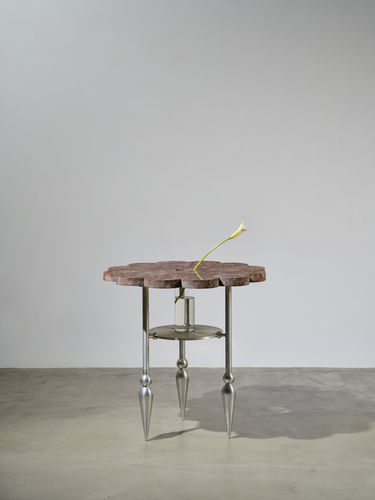
Born in Prague in 1949, Borek Šípek belonged to a generation of designers who profoundly renewed the language of European design at the end of the 20th century. After studying furniture design at the Academy of Arts, Architecture and Design in Prague, he left Czechoslovakia in 1968 and continued his architectural studies in Hamburg, before studying philosophy in Stuttgart and obtaining a doctorate in architecture from Delft University of Technology. This dual background, both theoretical and practical, had a lasting influence on his approach to design.
In 1983, he founded his studio in Amsterdam and began a decisive collaboration with Driade. Against the current of modern functionalism, Borek Šípek developed a personal vocabulary in which references to the Baroque, Surrealism, Bohemian glass, and the decorative arts engage with resolutely contemporary forms. His furniture is distinguished by asymmetrical silhouettes, vibrant colours, unexpected combinations, and great formal freedom, leading him to be frequently regarded as the father of Neo-Baroque in design.
Alongside furniture, Borek Šípek created glass objects, lighting, ceramics, architecture, and scenography. For him, no material should limit creation: blown glass, bronze, wood, metal, and porcelain all formed part of the same exploration, in which craftsmanship meets unconstrained imagination. This diversity explains the singular position he occupies within the international design landscape.
In 1992, Czech President Václav Havel appointed him architect of Prague Castle. For nearly a decade, Borek Šípek designed numerous interiors, furnishings, and architectural interventions intended to modernise the presidential spaces while respecting their historical heritage. This position confirmed his importance far beyond the world of design and testified to the international recognition he had achieved.
Borek Šípek’s creations are now held in the collections of the Centre Pompidou, the Vitra Design Museum, the Museum of Arts and Design in New York, as well as numerous public and private collections worldwide. Galerie Ketabi Bourdet highlights his historical furniture, particularly pieces from the 1980s and 1990s, which rank among the most emblematic works of European postmodern design.
Selected Bibliography
- Bořek Šípek, Vitra Design Museum.
- Style Forms Function, Borek Šípek.
- Atlas of Furniture Design, Vitra Design Museum.
- Centre Pompidou.
- Domus.
- Abitare.
Public Collections
- Centre Pompidou
- Vitra Design Museum
- Museum of Arts and Design, New York
- Prague Castle
- Czech National Collections