

A.R. Penck (1939–2017), born Ralf Winkler in Dresden, was one of the major figures of European Neo-Expressionism. Self-taught, he developed from the 1960s onwards a visual language based on pictograms, schematic figures, and signs inspired by both cave art and theories of information and cybernetics. An opponent of the East German regime, he was censored for many years before leaving the GDR for West Germany in 1980, where his work gained international recognition. Alongside his painting, from the late 1980s onwards he developed a remarkable body of ceramics, now considered an essential extension of his artistic vocabulary. Galerie Ketabi Bourdet is one of the first galleries in France to shed light on this still lesser-known aspect of his work.
-
 You can’t beat: The Taste of Death is sweet
 -
Boule
-
Würfel
-
Boule

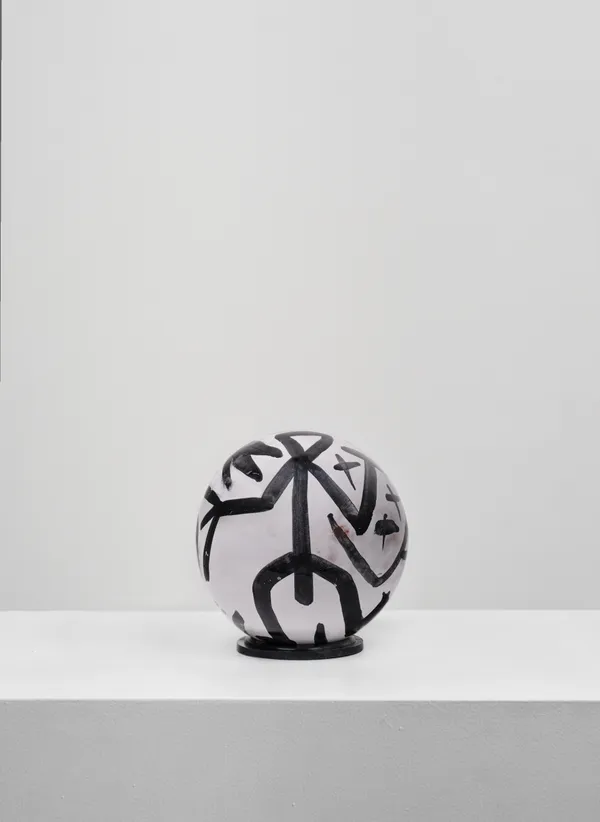


A.R. Penck, the pseudonym of Ralf Winkler (1939–2017), occupies a central place in the history of European art in the second half of the 20th century. Born in Dresden a few months before the outbreak of the Second World War, he grew up in a city devastated by bombing, an experience that profoundly shaped his worldview and informed his reflection on political systems, social structures, and mechanisms of communication.
Self-taught, Penck developed an immediately recognisable visual vocabulary from the 1960s onwards. Rejecting the socialist realism imposed in East Germany, he created compositions populated by schematic figures, pictograms, arrows, signs, and symbols, which he brought together under the term Standart. Inspired by cybernetics and information theory, he sought to create a universal language, accessible to the greatest number while leaving ample room for interpretation.
Long censored by the GDR authorities, he adopted several pseudonyms in order to evade political control, including A.R. Penck, borrowed from the geologist Albrecht Penck. Following his forced departure for West Germany in 1980, his work gained international recognition. He participated in major exhibitions devoted to European Neo-Expressionism, and his paintings, sculptures, and drawings quickly entered the collections of leading international institutions.
From 1987 onwards, Penck opened a new chapter in his practice by collaborating with Berlin-based ceramicist Kattrin Kühn. He conceived the forms — spheres, eggs, cubes, pyramids, plates, and egg cups — which Kühn produced before he intervened directly through painting. Each piece thus became a three-dimensional surface on which his graphic vocabulary could unfold freely. These works do not constitute a secondary practice but directly extend his pictorial research by introducing a tactile, sculptural, and spatial dimension.
Penck’s ceramics now occupy an essential place in the understanding of his work. They reflect his longstanding interest in “system models,” in which signs become tools for interpreting human, social, and political relationships. Each object therefore transcends its decorative function to become the vehicle for a broader reflection on the mechanisms of communication and thought.
Galerie Ketabi Bourdet actively contributes to the rediscovery of this exceptional body of work through PENCK / STARCK, the first exhibition in France devoted to the artist’s ceramics. Presented in dialogue with furniture by Philippe Starck, these works reveal a still largely unexplored facet of one of the great European artists of the 20th century.
-
Design de collection : les galeries françaises échappent aux tensions commerciales
Les galeries françaises dominent le secteur de ces pièces uniques ou en série très limitée, qui échappent aux droits de douane et atteignent des records aux enchères.Martine Robert, Les Echos, 23 June 2025 -
A.R. Penck and Philippe Starck: A Radical Dialogue of Objects at Ketabi Bourdet
Rare ceramics by A.R. Penck meet radical designs by Philippe Starck at Ketabi Bourdet Gallery, Paris, from September 4–27.Laurent Moïsi, Whitewall, 2 September 2025


Selected Bibliography
- A.R. Penck and Philippe Starck: A Radical Dialogue of Objects, Whitewall.
- PENCK / STARCK, Ketabi Bourdet (communiqué d'exposition).
- Centre Pompidou — A.R. Penck.
- Grove Art Online.
- Treccani — A.R. Penck.
Public Collections
- Centre Pompidou
- MoMA, New York
- Tate
- Stedelijk Museum
- Museo d’Arte di Mendrisio
- European Parliament