IN BETWEEN: Ketabi Bourdet - 22, passage Dauphine 75006 Paris

SCOTT BURTON, LE CORBUSIER, DONALD JUDD, DAN FRIEDMAN, ELIZABETH GAROUSTE, ALBERTO GIACOMETTI, REI KAWAKUBO, NICOLA L., FRANÇOIS-XAVIER LALANNE, JONATHAN MONK, FRANÇOIS MORELLET, ISAMU NOGUCHI, PAOLO PALLUCCO, NATHALIE DU PASQUIER, GUY DE ROUGEMONT, PHILIPPE STARCK, ROBERT WILSON
Galerie Ketabi Bourdet is delighted to present In Between, a group show featuring works by visual artists, designers and, more generally, artists working at the frontier between different artistic practices.
Like Bob Wilson, whose work the gallery has been promoting since 2022, the artists gathered here have made hybridity their creative territory. Wilson is not only a stage director, but also a scenographer, artist, designer and sculptor of light and body. He conceives his shows as moving tableaux, visual compositions of extreme precision. In Between showcases one of his stage drawings, preparatory drawings with dreamlike overtones, as well as a Hamletmachine chair, designed for his emblematic staging of Heiner Müller's play. For him, theater becomes plastic space, furniture becomes sculpture, and image takes precedence over speech.
This same permeability between disciplines is found in Élizabeth Garouste, a major figure in French creation. Since the 1980s, she has been developing a singular, baroque and poetic vocabulary in both design and the visual arts. From the sculptural resin coffee table reminiscent of Goldilocks and the Three Bears to her instinctive, gestural painting, Garouste's work is infused with vibrant energy and unfettered imagination. Garouste does not seek to separate the useful from the symbolic: his objects tell stories, his forms function as intimate mythologies. Too long confined to design, her work deserves to be understood in all its plastic and emotional richness.
Other artists in the exhibition also embody this fertile tension between art and design. François-Xavier Lalanne, with his ostrich egg ice bucket, creates works that are as much sculpture as furniture - or vice versa. His approach is in keeping with a surrealist, zoomorphic tradition, where function merges with form. Donald Judd, who is often associated with Minimalism, has always claimed that his furniture practice is indissociable from his sculptural work: the same formal rigor, the same quest for purity. Le Corbusier, represented here by a work on paper, is another example of a total creator, architect of course, but also painter, theorist and designer. His vibrant lines testify to his desire to unite art and living space, an idea dear to the modern movement. The same quest for a global language can be found in François Morellet, whose chair here illustrates the playful, geometric extension of his abstract research into design. Last but not least, Isamu Noguchi's Akari lamp sculpture, an essential figure of organic design, embodies the subtle alliance between sculpture, light and the poetry of everyday life.
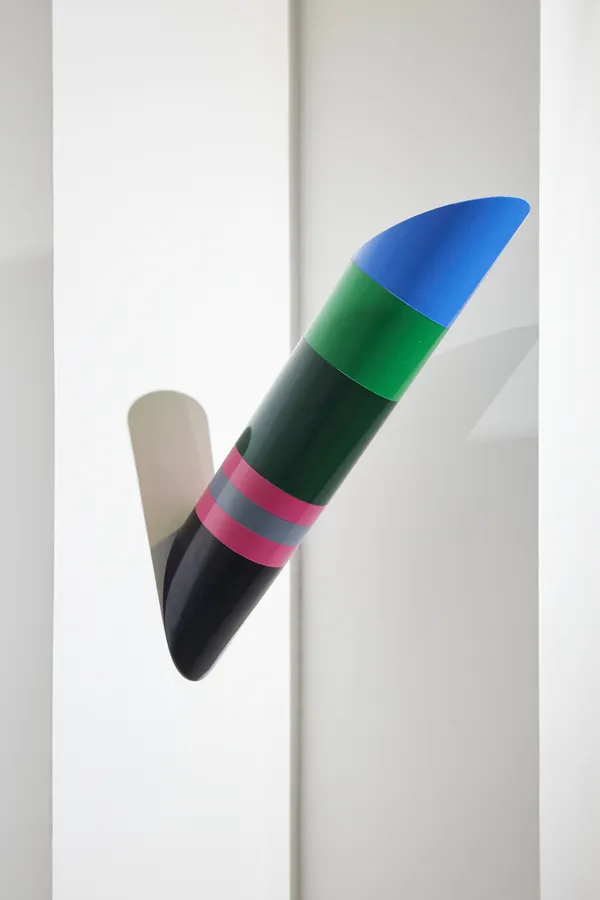
Featuring a painting by Nathalie Du Pasquier - co-founder of the Memphis movement - In Between also explores a postmodern, uninhibited aesthetic, where motifs, colors and shapes play with convention. Having moved from design to painting, Du Pasquier continues to reflect on structure, surface and composition, faithful to an approach in which disciplines freely respond to each other. In the same postmodern vein, the exhibition also features Philippe Starck's WW - a sitting/standing stool whose enigmatic silhouette, halfway between object and sculpture, questions the boundary between function and contemplation. Its totemic, almost architectural presence makes it an emblematic piece of a period when designers were emancipating themselves from codified practices. Finally, a chair n°33 by Rei Kawakubo - on loan for the occasion from a major European collection - completes this constellation. Known for redefining fashion codes through her Comme des Garçons brand, Kawakubo here transposes her radical language into a minimalist, conceptual piece of furniture, conceived as an architectural element punctuating the space of her boutiques.
In keeping with this logic of blurring boundaries, In Between also features a chair from Paolo Pallucco's legendary 100 chairs in one night series, first shown at Modena's Mazzoli gallery in 1990 (the first gallery to exhibit Jean-Michel Basquiat in Europe!). This series, which oscillates between performance, experimental furniture and critical sculpture, powerfully embodies the spirit of European postmodernism, with its blend of humor, subversion and extreme formal research. These works all continue the legacy of postmodernism, which opened up a space of formal and intellectual freedom in which artists and designers no longer have to choose a box, but can activate several registers at once.
A work on paper by Alberto Giacometti reminds us that, in addition to his slender, existential sculptures, he was also a subtle drawer and creator of sculptural furniture pieces whose lines reveal an almost tactile attention to the body. Nicola L., a pioneering and activist artist, also embodies this freedom of tone and form, creating works where body, object and narrative intertwine. Finally, the presence of Guy de Rougemont - whose estate the gallery has represented since 2024 - is a natural link in this constellation. A painting from the 1990s, with its architectural forms and vibrant colors, bears witness to his work between painting, sculpture, furniture and architecture: a global, free language, which the gallery continues to promote today.
What all these artists have in common is that, depending on the period and context, they have been classified as visual or decorative artists, but rarely as part of an overall reading of their work. This compartmentalization reflects a certain modern vision of creation, based on specialization and hierarchy between disciplines.
Yet it is precisely this reading that the gallery intends to question. Since its creation, it has been committed to defending artists who escape categories, who move freely between mediums, codes and customs. In Between is fully in line with this approach.
By bringing together these figures often considered unclassifiable, this exhibition affirms a position: that of a gaze that accepts grey areas, celebrates ambiguities and values transversal forms of expression. For it is in this in-between - neither quite art, nor quite design - that the most singular, freest and perhaps most contemporary works are sometimes born.
-
 Chaise Hamletmachine
-
Intérieur nuit chez M.R
-
Up and Down
-
Nicola L., Lampe Roman Emporor, Ca. 1989
-
Nicola L., Tête cultivée, Ca. 1970
-
Sans titre
-
Table basse Boucle d'or
-
François Morellet et Friquet Morellet, Chaise Paire-La-Chaise, Ca. 1998
-
Jonathan Monk, Ensemble de trois Restaurant Drawings (Alighiero Boetti incontri e scontri, Sol Lewitt Incomplete Open Cube, Donald Judd Stack), 2017
-
Jonathan Monk, Restaurant Drawing (Donald Judd: Backward Slant Chair 1982), 2024
-
Guéridon Central
-
100 sedie in una notte, Sedia 81 - Sedia del circondario per un appuntamento a spalla di spie
-
Rei Kawakubo, Chaise No.33 , ca. 1991
-
Scott Burton, Untitled (Maquette for Rock Sculpture), 1982
-
Untitled (Construction AAA)
-
Robert Wilson, Medea Act Five, Scene Thirteen, 1984
-
Donald Judd, Armchair 1, 1984-2025
-
Le Corbusier, Projet de sculpture, 1946
-
François-Xavier Lalanne, Seau à glace Oeuf, 1968 - 1984
-
Isamu Noguchi, Lampe Akari 21N, Ca. 1960
-
Alberto Giacometti, Tête d'Homme, Femmes Debout et Griffonnages, Ca. 1962