Guy de Rougemont, Peintre avant tout : Ketabi Bourdet - 22, passage Dauphine 75006 Paris

Guy de Rougemont’s abstract works bear witness to a lifelong engagement with colour, born from the artist’s early encounter with the luminous watercolours of J. M. William Turner in London’s museums and with the vibrant palettes of Henri Matisse and Pierre Bonnard. During an extended stay in New York between 1965 and 1966, the artist, steeped in European traditions, confronted the radical forms and flat colours of American Minimalist and Pop artists, including Andy Warhol, Frank Stella, and Robert Indiana. These encounters led him to definitively choose abstraction as a territory of exploration, allowing him to express his painterly curiosity without limits.
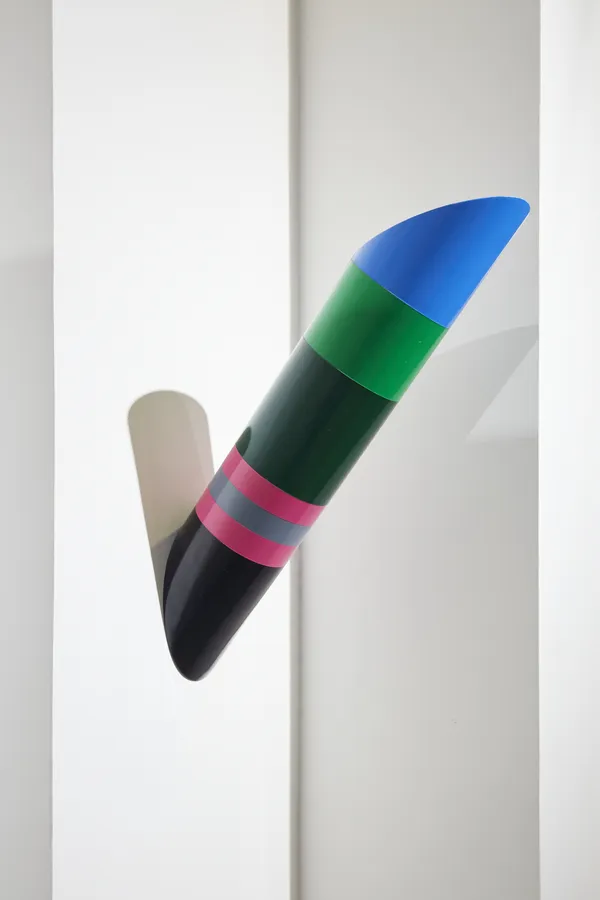
Painting lies at the core of Guy de Rougemont’s artistic practice, which he translates into volume in order to “make light and colour react, the true subject of painting,” as exemplified by the curves of his serpentine sculptures, which cut through beams of light in three-dimensional space. The simpler and more recognisable the artist’s geometric forms, the more vibrant and radiant the colour becomes, mastered by the colourist and conveying a joyful sense of play. “I believe in the transformative power of a colour, of the encounter between a curve and a straight line, of a touch of light,” the artist wrote in his notebooks. It is on canvas that his deepest doubts find expression, where the fruits of countless hours spent alone in his studio come to maturity.
“Within the temporality of the passage of time, in the vigour of our restless curiosities as painters, I understood that I would be a painter forever,” he wrote with serenity.
A carefully selected group of paintings and works on paper traces the artist’s journey, beginning with the curvilinear forms of the ellipse, intersected by straight lines to create surfaces receptive to flat colour. From the 1970s onwards, the straight line gradually took precedence over the curve, for a period spanning thirty years, during which the artist developed an infinite variety of geometric grids in which shadow and light resonate with one another, creating a perfect ambivalence between the fixity of the surface and the fleetingness of colour.
The artist’s meditation on the non-finito, explored before him by Leonardo da Vinci and Michelangelo, leaves unfinished areas visible on his canvases, emphasising the completion of the filled areas. These poetic works embody the underlying ambiguity that characterises his entire practice, in constant tension between his rigorous spirit, inherited from his military father, and his rebellious nature as a dreamer and artist. From the 2000s onwards, the artist returned to fluid forms and nuanced colours, developing a personal interpretation of the linea serpentinata used by the Italian Mannerist masters of the 16th century, Pontormo, Bronzino, and Parmigianino—the culmination of a sixty-year journey through the different states of colour. Guy de Rougemont died in 2021, leaving behind a singular formal universe in constant flux between artistic tradition and aesthetic rupture.
Julie Goy — Journalist and art historian, specialist in the work of Guy de Rougemont
-
 Again
Again -
Guy de Rougemont, Au vent du serment, 1999
-
Deux fois deux
-
Guy de Rougemont, À l'angle des saisons, 1995
-
Angle jaune sur flamboyant
-
Après le rêve
-
Intérieur nuit chez M.R
-
Guy de Rougemont, Lumière de là-bas, 1983
-
Guy de Rougemont, Non finito, 1975
-
Guy de Rougemont, Printemps, 1977
-
Guy de Rougemont, Sans titre, 2006
-
Guy de Rougemont, Sans titre, 1977
-
Guy de Rougemont, Sans titre, 1966
-
Guy de Rougemont, Sans titre, 2001
-
Guy de Rougemont, Sans titre , 2000
-
Guy de Rougemont, Sans titre, 2000
-
Guy de Rougemont, Sans titre, 2000
-
Guy de Rougemont, Sans titre, 2000
-
Guy de Rougemont, Tableau, 1977
-
Up and Down