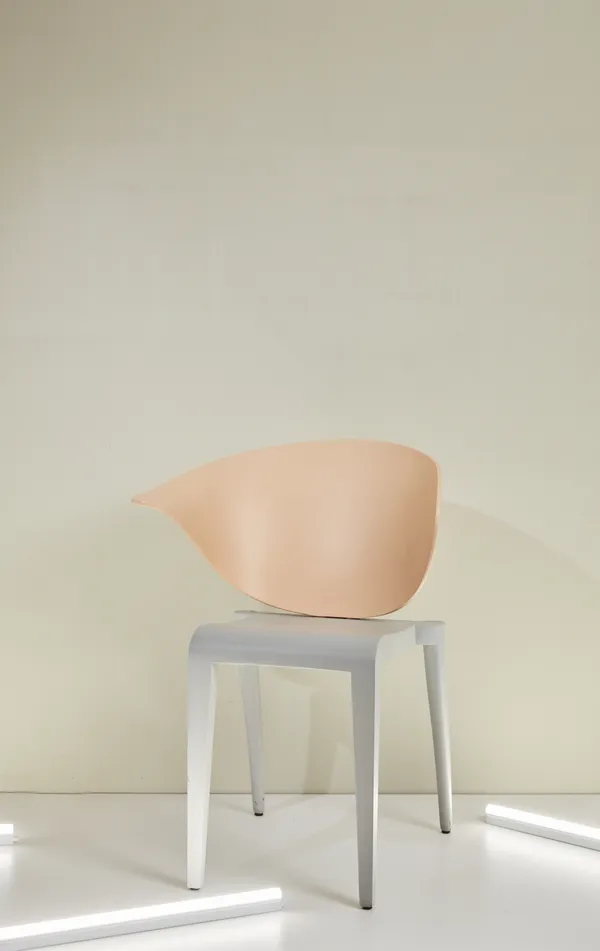
Philippe Starck, an ‘eco-conscious’ designer, incorporated nature into his creations from an early stage.
Eco-design by mail order?
Philippe Starck, often described as an “eco-minded” designer, integrated nature into his work from a very early stage. He is himself a man of nature, surrounded by mud, waves, and forest, living in isolation in the woods—much like the Maison 3 Suisses that he designed and inhabited in the Paris region in the 1990s. His creations contain aesthetic and formal references to nature. For example, the W.W. stool (1990) evokes, in his own words, the “strength of young vegetation,” while the Étrangeté vase (1989), with its elongated shape, recalls both a drop of water and a spermatozoon.
Less radical and minimal than his black metal furniture of the 1980s, these works foreshadow Starck’s growing interest in the common good and the messages he would convey through his designs from the 1990s to the present day. Although here the evocation of nature remains primarily stylistic—much like Art Nouveau a century earlier—Philippe Starck would go further in 1994 and 1995 with the Maison Starck and the Bo Boolo collection for 3 Suisses.
Ecological Architecture
Building on his collaboration with the mail-order catalogue 3 Suisses, which began in 1984, Philippe Starck drove the point home in 1994 with the Maison Starck. For 4,900 francs, delivered within twenty-four hours, one could buy the house of one’s dreams—and not just any house, but the designer’s own. At that price, however, one was not purchasing a fully built house, but rather a box set containing a notebook, the construction binder, plans signed by Patrick Bouchain, a VHS tape in which Starck presents his house, a hammer to drive the first nail, and a flag to hoist on the roof ridge to celebrate the completion of the works. No need to worry if the hammer did not quite fit its designated slot: Stanley having run out of the initially planned model, it was replaced in some boxes by a version with a shorter handle.
Purchasing the box entitled the buyer to build a 140 m² house—the maximum surface area in France that can be built without an architect. Construction costs amounted to approximately one million francs, around €250,000, with the budget varying depending on the options chosen. Despite the 500 box sets sold, only about twenty houses are thought to have actually been built. This wooden house, somewhere between a Canadian cabin, a Cap Ferret beach house, and a Swiss chalet, draws on childhood imagery to propose an architecture that can be adapted anywhere and invites dreaming. Although the project remained, for obvious reasons, largely utopian, it testifies to a genuine desire to offer an affordable, high-quality alternative to the soulless, low-end architecture that was proliferating across France at the time. Today, the box set has become an iconic object and is part of the collections of numerous institutions, such as the Musée des Arts Décoratifs in Paris, where it is regularly exhibited.
Ecological Design
The following year, Starck brought the forest into the home. Once again with 3 Suisses for the Autumn–Winter 1995–1996 season, he designed the Bo Boolo collection: a bench, a table, and a console. Only the tabletop and legs were delivered, accompanied by assembly instructions, a numbered plaque, and a toll-free number. This number allowed buyers to contact the nearest forest ranger from the French National Forestry Office (within a maximum radius of 150 km) to arrange a visit during which the ranger would cut the birch trunk serving as a spacer, embed the numbered brass plaque into it, and sign the certificate of authenticity.
Although Starck considers ecology to be a cyclical trend, bringing nature—and in this case a raw tree trunk—into people’s homes, while involving the National Forestry Office to raise awareness and remind us that the wood furniture is made from comes from somewhere, is a genuinely ecological gesture. As is often the case with the designer, the message goes beyond the object itself and gives it meaning. It is worth noting that Starck chose the Bo Boolo table as his own personal desk. Approximately 300 pieces in total were produced by 3 Suisses. The collection was later produced in slightly different dimensions by XO, which created several special versions, including a console for the lobby of the Delano Hotel in Miami.
In terms of ecology, Starck’s strongest gesture may well be the Jim Nature television set, designed in 1994. For Thomson/SABA, he conceived a television at odds with conventional standards: instead of molded plastic shells, it featured casings made of wood particleboard. Anticipating contemporary recycling practices, these shells were produced using sawdust recovered from sawmills. As often with Starck, the gesture was symbolic, yet one can imagine that watching one’s favorite program on a wooden television rather than a black plastic one may have sparked a few ecological vocations.
Where Starck truly excels is in summoning collective memory and archetypes through the objects he references, not without a touch of surrealism. In 1989, he revisited the traditional rustic woven-seat chair for Driade with a collection of six models, each stranger than the last: Tessa Nature, Placide of the Wood, Dick Deck, Anna Rustica, Bob Dubois, and Jane Paille. In 1995, he created the armchair Ceci n’est pas une brouette for XO, a curious hybrid between a wheelbarrow and a sedan chair, directly inspired by a 1937 photograph by Man Ray. In 2003, with Attila, Napoléon, and Saint-Esprit for Kartell, he achieved one of his greatest commercial successes and brought the garden gnome—an icon of bad taste—into fashionable interiors, even those designed by Jacques Grange.
He went further in 1998, once again through mail order, this time with La Redoute, launching Good Goods: a catalogue listing products that are good, durable, honest, and responsible for modern, rebellious consumers. “These objects, I am offering to you today in this catalogue, which I would like to call a catalogue of ‘non-products for non-consumers.’ Conscious and wary non-consumers, but also open and creative, enthusiastic and ultimately profoundly countercultural—modern.”
His ultimate committed gesture came in 2008, when he designed a flat, transparent, reusable water bottle for the Fondation France Libertés. La Feuille d’eau was produced in 19,000 copies. The plastic bottle, inscribed with the phrase “A common good of humanity, water has no price,” was distributed to 337 Parisian primary schools, as children are excellent advocates within their families. The initiative served as a reminder that tap water is both more economical and more ecological than bottled water.
It thus appears evident that nature and its protection run like a common thread through Philippe Starck’s entire body of work. Although he is not, strictly speaking, an eco-designer, he seeks to alert, raise awareness, and propose objects that are more respectful of both consumers and their environment.
The gallery will also present a series of original photos shot by Tom Vack in the late 1980s. A moment of light suspended in time, this series of original archive films represents the shots taken for Philippe Starck's Aleph catalogue for Driade in the early 1990s in Piacenza (Italy). Authentic and unique works, the transparencies capture the light of a precise moment, fixed forever on film. Each film is a witness of that moment.
In an era before Photoshop, the challenge was to capture two sides of the product simultaneously in a single image – real and reflected – thanks to a skilful play of mirrors and lighting. Each film is a unique piece, part of a series with different exposures, tangible evidence of a time when photography was pure light and intuition.
-
 Chaise Jane Paille
-
Philippe Starck (b. 1949), Fauteuil Ceci n'est pas une brouette, Ca. 1994
-
Anonyme, Maquette Maison les 3 Suisses de Philippe Starck, 2025
-
Banc Bo Boolo
-
Philippe Starck (b. 1949), Bureau Bo Boolo commande spéciale, Ca. 1995
-
Chaise Anna Rustica
-
Chaise Bob Dubois
-
Chaise Boom Rang
-
Chaise Dick Deck
-
Chaise Placide of the Wood
-
Chaise Tessa Nature
-
Coffret Maison Starck
-
Philippe Starck (b. 1949), Console Bo Boolo, Ca. 1995
-
Console Bo Boolo
-
Philippe Starck (b. 1949), Grand vase Étrangeté, Ca. 1986
-
Jim Nature
-
Philippe Starck (b. 1949), Tabouret Attila, Ca. 2001
-
Philippe Starck (b. 1949), Tabouret Napoléon, Ca. 2001
-
Philippe Starck (b. 1949), Tabouret Saint Esprit, Ca. 2001
-
Tabouret W.W.
-
Vase Popopo