

« I am a painter above all. »
Guy de Rougemont (1935–2021) was one of the leading figures of French abstraction in the second half of the 20th century. A painter, sculptor, draughtsman and furniture designer, he developed over more than six decades a body of work centred on colour, geometry and their integration into space. Influenced by his stay in New York in the 1960s and his encounters with Pop Art and Minimalist artists, he developed a distinctive visual language in which ellipses, cylinders, gridded surfaces and sinuous lines became the defining elements of an immediately recognisable universe.
Elected to the Académie des Beaux-Arts in 1997, Guy de Rougemont is now regarded as one of the major figures of French abstraction. The Ketabi Bourdet gallery represents his estate and regularly presents exhibitions, publications and works at leading international art and design fairs.
-
 Up and Down
 -
Untitled
-
Linea serpentinata
-
Sans titre
-
Après le rêve
-
Intérieur nuit chez M.R
-
Deux fois deux
-
Again
-
Oui


« Colour is an architecture of space. »
The gallery is honoured to represent the estate of French artist Guy de Rougemont (1935–2021).
Guy de Rougemont was born in Paris in 1935. He was introduced to art at an early age, painting watercolours with his American paternal grandmother, whom he credited with inspiring his first artistic impulses. In 1954, he was admitted to the École Nationale Supérieure des Arts Décoratifs, where he devoted himself primarily to painting and joined the studio of French painter Marcel Gromaire (1892–1971).
His first solo exhibitions were held abroad, notably at the d’Arcy Gallery in New York in 1962. From 1962 to 1964, he was awarded a French state scholarship to the Casa de Velázquez in Madrid, and presented his work at the Ateneo Mercantil gallery in Valencia in 1964. He then spent 1965 in New York with his friends Jean and Irène Amic, where he encountered young artists from the New York scene, including Andy Warhol, Robert Indiana and Frank Stella. He embraced large-scale acrylic painting and explored the power of simplified forms and flat colour. His work is often associated with Pop Art and Minimalism, whose forms influenced him, although he never claimed allegiance to either movement. Four major periods can be identified throughout Guy de Rougemont’s career, defined by the geometric forms that shaped his work.
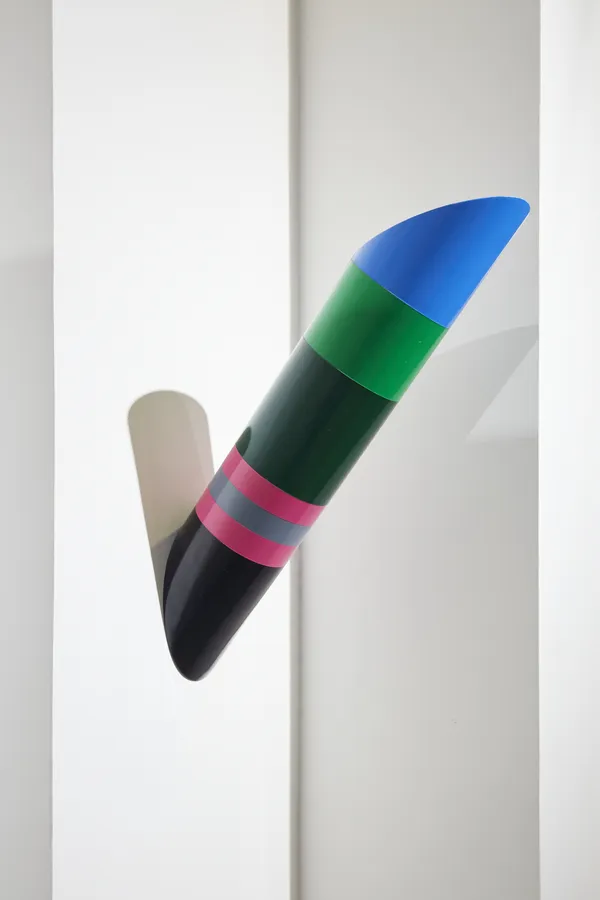
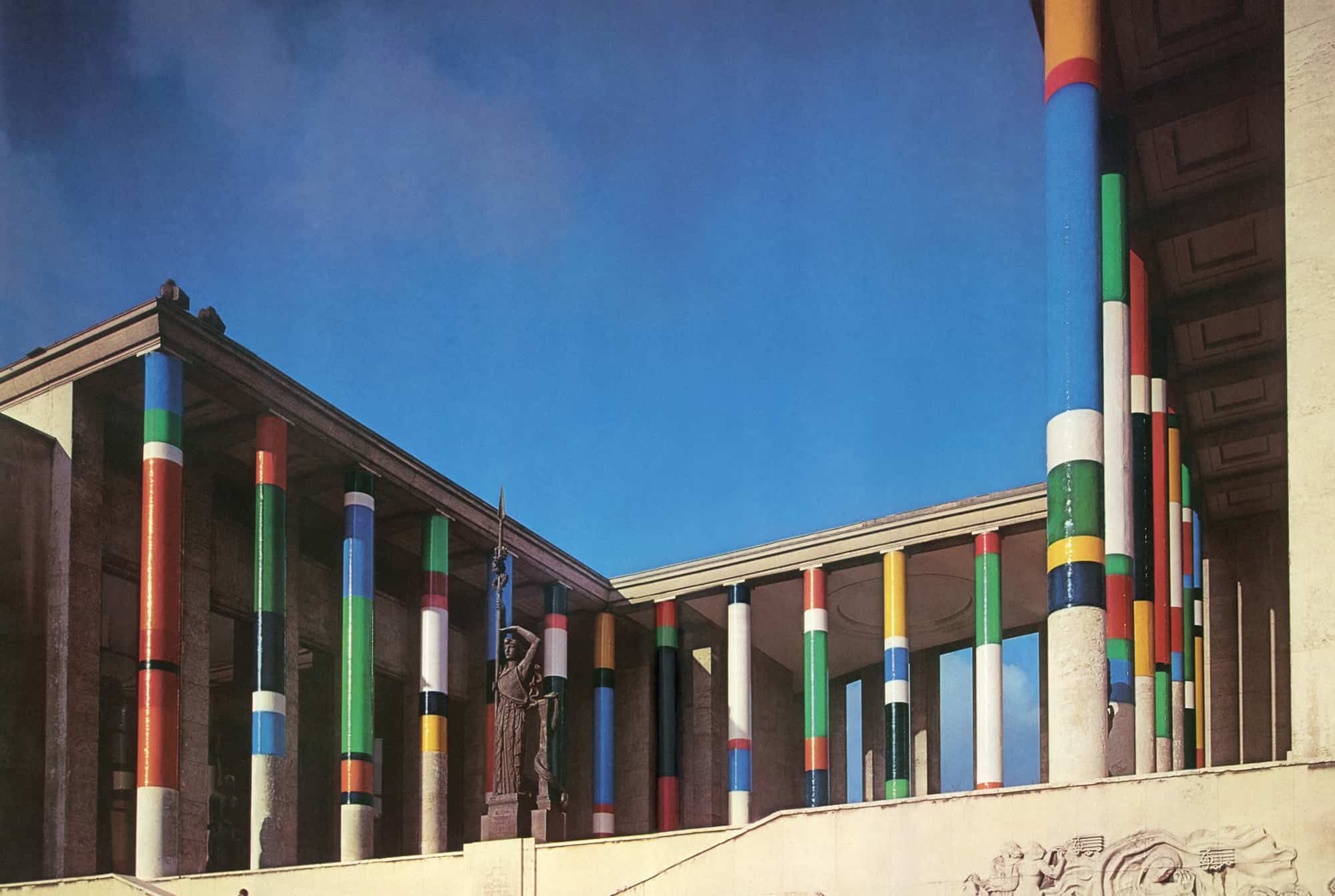
From 1965 onwards, he introduced the ellipse, developing it across the surface of his canvases. In 1967, he created an environment for the Hall Fiat on the Champs-Élysées in Paris, installing canvases cut into elliptical shapes within the exhibition space and establishing a dialogue between art and the automobile. Following this project, he began creating his first three-dimensional objects. During the 1970s, he began working with the cylinder, a geometric form he considered the perfect combination of circles and lines. He used it to place polychrome volumes within space, creating large cylinders, also known as “totems”, “columns” or “markers”, which appeared in urban settings, such as Place Albert Thomas in Villeurbanne, as well as in interior spaces, including his Colonnes de table. Mise en couleurs d’un musée, presented at the Musée d’Art moderne de la Ville de Paris in 1974, marked the culmination of his use of the cylinder. The artist temporarily covered the museum’s twenty portico columns with coloured PVC, playing with the boundaries between interior and exterior and extending his work onto the museum forecourt.
At the end of the decade, and particularly during the 1980s, the artist moved away from the cylinder towards the gridded surface. In 1986, he created one of his major works: the mosaic of coloured marble that adorns the pavement of the Bellechasse forecourt in front of the Musée d’Orsay in Paris.
Finally, from the 2000s until the end of his life, the artist developed the sinuous line, marking a pronounced return to curved forms. His sources of inspiration included his observation of the Old Masters, particularly Henri Matisse, as well as contemporary artists, notably his long-time friend Eduardo Arroyo (1937–2018), who said of him that he « applies his language to the universe. »
Like many artists of the 20th century, the artist sought to break down the boundaries between artistic disciplines. His aim was to bring colour into the spaces of everyday life, drawing on every artistic medium available to him. Nevertheless, he described himself as a painter above all—a distinction formally recognised by his peers when he was elected to the Académie des Beaux-Arts in 1997, to the seat reserved for a painter.
Guy de Rougemont died in August 2021.
Text by Julie Goy, art historian and co-curator of the exhibition Incursion dans l’Atelier de Rougemont, Palais de l’Institut de France, Paris 6th arrondissement.

Courtesy Fonds Guy de Rougemont
-
Incursion dans l'atelier de Rougemont
L’Académie des beaux-arts rend hommage à l’œuvre polyphonique de Guy de Rougemont (1935- 2021)Julie Goy, Communiqué de presse - Académie des Beaux-Arts, 11 July 2024 -
Les essentiels du jour
Télex 15.07Rafaël Pic, Quotidien de l'Art, 15 July 2024 -
KETABI BOURDET REPRÉSENTE L'ESTATE DE GUY DE ROUGEMONT
Projets Media, 18 July 2024 -
Ketabi Bourdet représente l'estate de Guy de Rougemont
La Gazette Drouot, 19 July 2024 -
"GUY DE ROUGEMONT: PEINTRE AVANT TOUT" À LA GALERIE KETABI BOURDET
GOODMOODS, 14 October 2024 -
Le génie protéiforme de Guy de Rougemont
N. d'A., L'OBJET D'ART, 1 November 2024 -
Bel effet de nuage pour Guy de Rougemont
Un nouveau succès éclairait la table basse de Guy de Rougemont, et ce n’est sûrement pas le dernierAnne Doridou-Heim, La Gazette Drouot , 12 December 2024 -
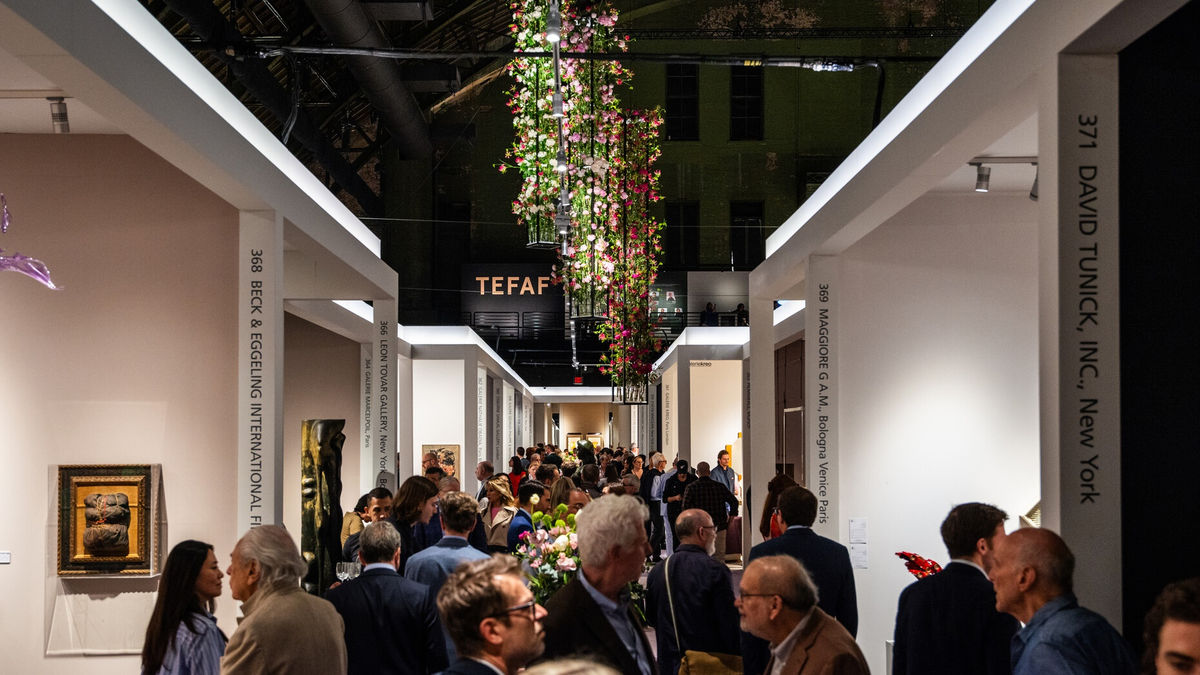
TEFAF dévoile la liste des exposants de Maastricht
15 - 20 mars 2025 TEFAF Maastricht, Pays-BasMeer, 1 March 2025 -
Qu'est-ce qui fait courir la jeune génération de marchands à la Tefaf Maastricht ?
Béatrice de Rochebouët, Le Figaro Culture, 13 March 2025 -
Un nuovo capitolo
Nella storica cornice di palazzetto Taverna, la maison rende omaggio alle sue origini e al legame con Milano, nel segno di un'inedita idea di lusso contemporaneoGiada Storelli, Architectural Digest, 1 June 2025 -
A Basilea c’è una nuova fiera: MAZE Design Basel, per il design da collezione.
Intervista a Charlotte Ketabi e Thomas HugSilvia Conta, IL GIORNALE DELL'ARTE, 12 June 2025




-
Guy De Rougement, LA LIGNE SERPENTINE
KETABI BOURDET - 22, PASSAGE DAUPHINE 75006 PARIS 5 March - 11 April 2026Following Guy de Rougemont, peintre avant tout in October 2024, which offered a retrospective of the artist's painted production from 1965 to the 2000s, this new exhibition-sitting between painting and...Read more -
IN BETWEEN
Ketabi Bourdet - 22, passage Dauphine 75006 Paris 24 April - 22 May 2025Galerie Ketabi Bourdet is delighted to present In Between, a group show featuring works by visual artists, designers and, more generally, artists working at the frontier between different artistic practices....Read more -
Nouvelles Résolutions Vol.II
Ketabi Bourdet - 22, passage Dauphine 75006 Paris 28 November - 21 December 2024WITH WORKS BY:Read more
PAULINE D’ANDIGNÉ
IDIR DAVAINE
GUY DE ROUGEMONT
JO FISH
ELIZABETH GAROUSTE
AUDREY GUTTMAN
ARTHUR LEMONIER
INÈS LONGEVIAL
PAOLO PALLUCCO
BRUNO ROUSSEAUD
ARA STARCK
PHILIPPE STARCK
JULIEN SAUDUBRAY
JEAN-MICHEL WILMOTTE -
Guy de Rougemont, Peintre avant tout
Ketabi Bourdet - 22, passage Dauphine 75006 Paris 10 October - 9 November 2024Guy de Rougemont’s abstract works bear witness to a lifelong engagement with colour, born from the artist’s early encounter with the luminous watercolours of J. M. William Turner in London’s...Read more


Bibliographie sélective
- Guy de Rougemont, Norma, 2024.
- Gay Gassmann, Guy de Rougemont.
- Julie Goy, Incursion dans l’atelier de Rougemont.
- Architectural Digest.
- Connaissance des Arts.
- L’Objet d’Art.
- La Gazette Drouot.
Collections publiques
- Centre Pompidou
- Musée d’Orsay (commande du parvis Bellechasse)
- CNAP
- Académie des beaux-arts
- nombreuses collections publiques françaises.