Overview

Cube, 1991
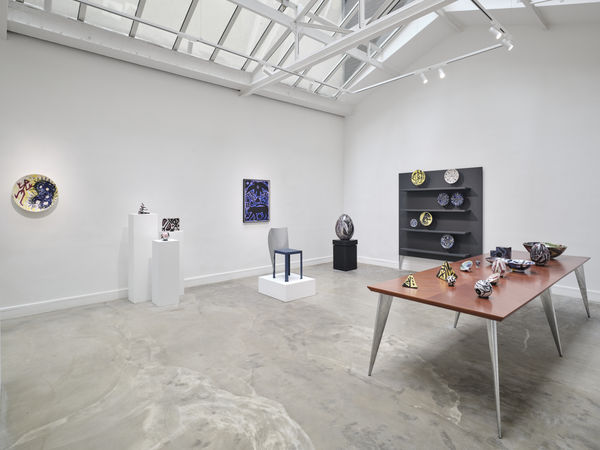
Galerie Ketabi Bourdet is delighted to present, in collaboration with Vincent Fraikin, PENCK / STARCK: an unprecedented encounter between two major figures of the 1980s and 1990s in Europe—A.R. Penck and Philippe Starck.
Ketabi Bourdet Gallery is pleased to present, in collaboration with Vincent Fraikin, PENCK / STARCK: an unprecedented encounter between two major figures of the 1980s/90s in Europe – A.R. Penck and Philippe Starck.
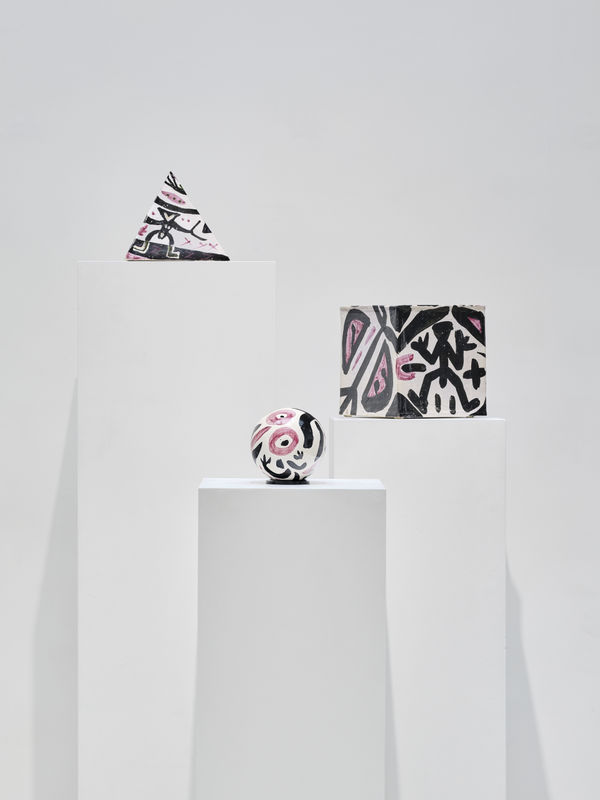
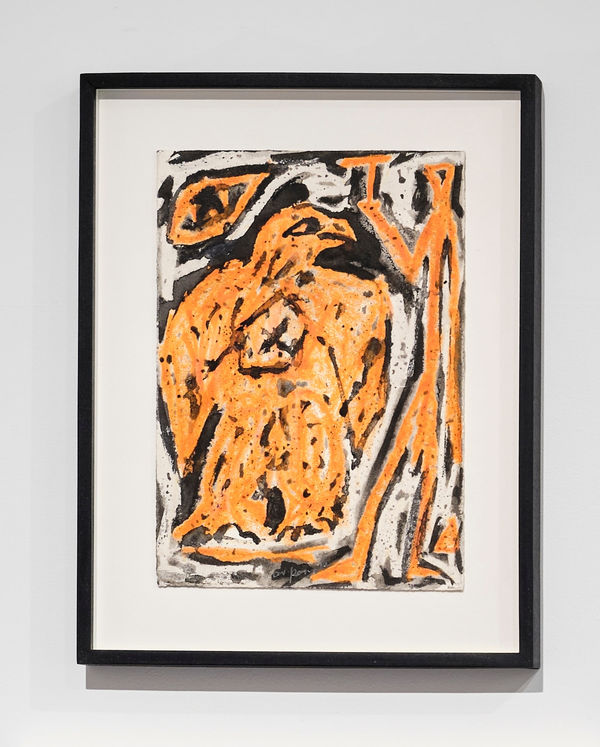
This is the first time in France that an exhibition sheds light on Penck’s ceramics, a still largely unknown yet essential facet of his work. These pieces originated in Amsterdam at the Aschenbach Gallery, where Penck painted his first ceramics. But it was in Berlin, in the studio of Kattrin Kühn—a ceramist friend who shaped his forms from 1988 to 1998—that this work truly took on its full scope. The majority of the works shown here were created there. Penck would convey his ideas for the shapes, which Kühn would craft, and he would then paint over them as if they were blank canvases. The German artist, a central figure in the European neo-expressionist scene, developed through this body of work an astonishingly free practice at the intersection of painting and sculpture: his symbols become three-dimensional, tangible, and tactile. His ceramics are simultaneously sculptures, objects, and fragments of a global system of thought—the “system models,” as he called them.
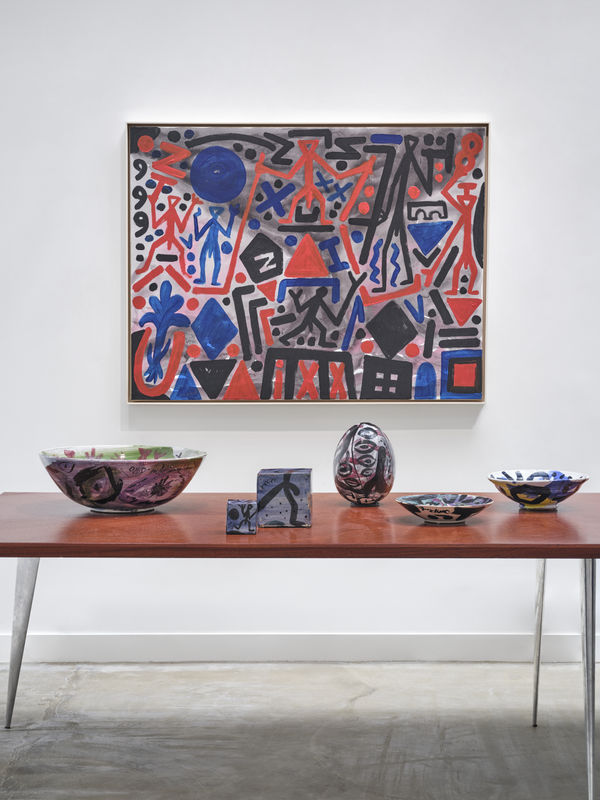
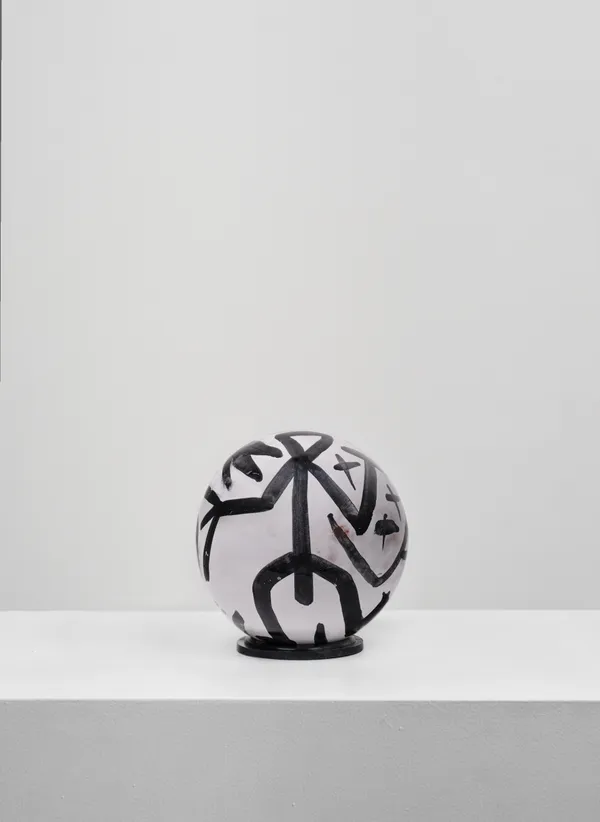
Balls, eggs, pyramids, cups, dishes, or egg cups: so many shapes in which Penck’s distinctive visual language—pictograms, figures, signs—takes root in matter and becomes volume. Each object thus transcends its decorative or utilitarian nature to belong to a broader and more radical artistic dimension. The exhibition brings together around twenty unique ceramics by Penck, all displayed on furniture designed by Philippe Starck. On this occasion, the gallery has assembled an exceptional collection of rare or unique pieces by the iconic designer of the 1980s. Although Penck and Starck never met, the same radical spirit, freedom, and intensity inhabit their works, establishing a dialogue that is as unexpected as it is powerful.
For the first time ever, the gallery is delighted to present an exceptional and extremely rare ensemble from the café “Mystique” in Tokyo, designed in 1988 by Philippe Starck and closed in 1998. When the café shut down, a few pieces were salvaged by employees, while the rest were destroyed. This is the only set from the café ever to appear on the market. The Miss Milch (1987) and Phil Lizner (1987) chairs, both created exclusively for the Japanese market, will structure the exhibition space with their radical presence. The Howard bookcase (1987), as minimal as it is radical, will house a collection of painted plates, like small paintings scattered against the piece’s black background. Penck’s objects will also be displayed on Starck tables, such as the Titos Apostos (1985) and Lang (1988) models. Finally, the floor lamp Soudain le sol trembla (Suddenly the ground shook, 1981), poised between sculpture and light source, will provide a more domestic illumination for Penck’s pieces.
In both Starck’s and Penck’s work, objects are never limited to their function: they question, displace, provoke. The exhibition thus offers a unique artistic experience, bringing together two creators from the same era: one fleeing the Eastern Bloc to reach the West, the other boldly embracing the communication society.
In both Starck’s and Penck’s work, objects are never limited to their function: they question, displace, provoke. The exhibition thus offers a unique artistic experience, bringing together two creators from the same era: one fleeing the Eastern Bloc to reach the West, the other boldly embracing the communication society.
Works
-
 A.R. Penck, Boule, 1990
 -
Boule
-
A.R. Penck, Cube, 1990
-
A.R. Penck, Ei (Œuf), 1992
-
A.R. Penck, Egg, 1992
-
A.R. Penck, Cube, 1991
-
A.R. Penck, Egg, 1992
-
A.R. Penck, Ohne Titel (zwei tanzende Männer), Ca. 1989
-
A.R. Penck, Plate, 1990
-
A.R. Penck, Plate (motif with 2 figures), 1989
-
A.R. Penck, Antagonismus, 2002
-
A.R. Penck, Maquette du catalogue de l’exposition de la Galerie Gillespie–Laage–Salomon, 1981
-
A.R. Penck, Deutschland Aktuell, 2.05.1993
-
A.R. Penck, DUNKLE BEDROHUNG, 2005
-
A.R. Penck, Man Adler 6, 1998
-
A.R. Penck, Dazwischen, 2002
-
A.R. Penck, Plate (motif with 4 figures), 1989
-
A.R. Penck, Pyra, 1990
-
A.R. Penck, Pyramide, 1990
-
A.R. Penck, Sans titre
-
A.R. Penck, Sans titre
-
A.R. Penck, Sans titre, 1988
-
A.R. Penck, Sans titre, 1988 - 1995
-
A.R. Penck, Sans titre
-
A.R. Penck, Sans titre, Ca. 1987
-
A.R. Penck, Sans titre, Ca. 1958-1960
-
A.R. Penck, Sans titre (Computercrash), Ca. 1992
-
A.R. Penck, Sans titre (Löwe)
-
A.R. Penck, Sans titre (Pyramide), Ca. 1990
-
A.R. Penck, Schale mit Selbstbildnis, 1991
-
A.R. Penck, STANDART, 9.6.1990
-
A.R. Penck, STANDART, 1990
-
A.R. Penck, Tasse, Ca. 1990-1993
-
A.R. Penck, Tasse, Ca. 1990-1993
-
A.R. Penck, Wahrschauer packt ein!, 1990
-
A.R. Penck, Weltenschale (world bowl), 1996
-
A.R. Penck, Weltraum System Immanenz (Space System Immanence), 1976 - 1980
-
Würfel
-
You can’t beat: The Taste of Death is sweet
-
Boule
-
Banquette Len Niggelman
-
Bibliothèque Howard
-
Chaise Miss Milch
-
Philippe Starck, Chaise Mystique, Ca. 1988
-
Philippe Starck, Chaise Mystique, Ca. 1988
-
Fauteuil Len Niggelman
-
Philippe Starck, Guéridon Mystique, Ca. 1988
-
Philippe Starck, Lampadaire Soudain le sol trembla, Ca. 1981
-
Philippe Starck, Miroir L'oreille qui voit, Ca. 2008
-
Portemanteau Franco Bull
-
Table Titos Apostos
-
Très probablement unique table modèle Lang





Installation Views